

The Government’s landmark 10 Year Health Plan for England, “Fit for the Future“, was published on 3 July 2025. The Plan aims to create a new model of care, building on the NHS’ founding principles and redesigning how the NHS delivers so that patients have real choice and control over their care.
Brevia Health has examined the Plan and our insight on the new NHS operating model can be found below. If you require more detailed insight on the 10 Year Health Plan and how the publication will impact your organisation, please contact Brevia Health (+44 (0)20 7091 1655 or email contact@breviahealth.com). For a full list of support options, please visit our services page.
Introduction
The Government’s landmark 10 Year Health Plan for England, “Fit for the Future”, was published on 3 July 2025. It set out three strategic “shifts”:
- From delivering care in hospitals to delivering care closer to home, in communities and in primary care
- To digital transformation of service delivery
- From a service treating sickness to one focused on preventing illness occurring in the first place
New NHS Operating Model
The 10 Year Health Plan sets out a new NHS operating model, “to deliver a more diverse and devolved health service”.[1] Key features of the new model include:
- Smaller central system: DHSC and other national bodies will operate with leaner headquarters and a sharper focus.
- Focused priorities: Fewer key targets and mandated objectives to drive strategic alignment.
- Regional oversight retained: Seven NHS regions continue to manage performance and provider oversight.
- ICB’s re-focussed: Integrated Care Boards will emphasise strategic commissioning and population health outcomes.
- Performance-based framework: Introduction of a “failure regime” for poor performers and incentives for high-performing organisations.
- Data, transparency, and patient choice: Providers and commissioners measured against clear metrics; performance information shared with patients.
- Patient-centred metrics: Patient-reported outcomes, experience and feedback integrated into performance assessments and supported by a new choice charter.
Features of the new ‘centre’ include:[2]
- Consolidated HQ: Consolidated NHS-DHSC headquarters with 50 per cent fewer staff by 2027.
- Strategic partnerships: Engagement with investors, industry, local government, employers, SMEs, voluntary organisations, and trade union.
- Ongoing oversight: Continued responsibility for national performance management and provider oversight.
Other key developments include:[3]
- Integrated Care Boards (ICBs)
- Strategic commissioning role: ICBs will be responsible for local health service commissioning, covering all but the most specialised services, using multi-year budgets.
- Efficiency and agility: ICBs are expected to deliver efficiency savings, reduce duplication, and operate in a lean, agile manner.
- Commissioning of neighbourhood providers: ICBs will select the best, most appropriate local providers within their footprint.
- National support programme: The government will implement a programme to strengthen ICB capability, including a new commissioning framework.
- Legislative change on governance: Provider organisations will no longer have board representation on ICBs.
- Focus on coordinated, strategic decision-making: ICBs are intended to streamline local planning and commissioning to improve outcomes and system efficiency.
- Earned Autonomy for Providers
- Autonomy linked to performance: Local providers performing well will gain greater freedom and flexibility from central oversight.
- National ambition: The plan aims for high autonomy across all regions, creating a more empowered provider network.
- Performance monitoring and support: NHS regions will use a rules-based process to identify underperformance, backed by a failure regime and diagnostic reviews.
- Focus on areas with worst outcomes: Priority will be given to addressing persistent underperformance and poor health outcomes.
- Modernised foundation trust model: New and existing FTs will emphasise partnership working, population health outcomes, and operational flexibility.
- Long-term goal: By 2035, all NHS providers are expected to become foundation trusts, maintaining high standards of quality, access, and financial sustainability.
- Plurality of Provision
- Encouraging diversity in service delivery: The plan seeks to expand the range of organisations delivering NHS services.
- ICBs shaping provider landscape: Integrated Care Boards will be supported to develop innovative service models, not constrained by traditional structures.
- Continued role for private providers: Private sector capacity will be used to improve access and reduce waiting times, helping the NHS meet its constitutional standards.
- Targeting disadvantaged areas: Discussions will take place with private providers to expand NHS provision in areas with the greatest need.
- Focus on innovation and flexibility: Emphasis on new ways of arranging services to improve patient outcomes and system efficiency.
- Complementary use of all providers: NHS planning will integrate public, private, and third-sector providers to deliver care efficiently.
- A New Partnership with Local Government
- Clear NHS-local government integration: Policy aims to move from fragmented working to joint action across health, social care and wider public health.
- ICBs aligned to local authorities: ICBs will be encouraged to match combined authority boundaries, strengthening regional coordination.
- New joint planning model: Neighbourhood health plans will be developed by NHS and local government and consolidated into population health improvement plans that guide commissioning.
- Simplified system architecture: Integrated Care Partnerships will be abolished, with clearer accountability through Health and Wellbeing Boards and ICBs.
- Shift to prevention and population health: Selected areas (e.g. Greater Manchester) will act as prevention demonstrators, with pooled budgets and greater autonomy.
- Power to Patients and the Public
- Shift of power to local systems and providers: Decision-making and influence will move away from the centre toward local NHS organisations and integrated care systems.
- Introduction of a Choice Charter: A new framework to strengthen patient voice, choice, and feedback in NHS funding and service delivery.
- Expansion of personal health budgets (PHBs): Patients will gain greater control over how NHS resources are used for their care.
- Digital empowerment via NHS App: Patients will have enhanced tools to manage their health and care, improving accessibility and self-management.
- Direct access to diagnostic services: Where safe and appropriate, patients will be able to refer themselves to diagnostic services, reducing unnecessary gatekeeping.
- Elective treatment choice: Patients will be able to choose between different providers based on waiting times, quality, outcomes, and patient experience.
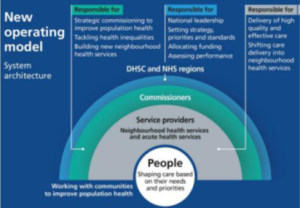
Operating model structure (visual representation):[4]
The Plan includes a useful visual representation on how the new operating model will be structured:
Support from Brevia Health
If you require more detailed insight on the work of the 10 Year Health Plan, please contact Brevia Health (+44 (0)20 7091 1655 or email contact@breviahealth.com). Further information on our three key service offerings can be found at: public affairs, public relations and market access.
Notes
[1] DHSC, 10 Year Health Plan for England: fit for the future, 3 July 2025, Link
[2] DHSC, 10 Year Health Plan for England: fit for the future, 3 July 2025, Link
[3] DHSC, 10 Year Health Plan for England: fit for the future, 3 July 2025, Link
[4] DHSC, 10 Year Health Plan for England: fit for the future, 3 July 2025, Link